Everything you need to know
about powder coating.
From its definition and composition to the production process, electrostatic application and curing, its advantages and environmental impact — all the details of powder coating technology on a single page.
What is powder coating,
and how does it work?
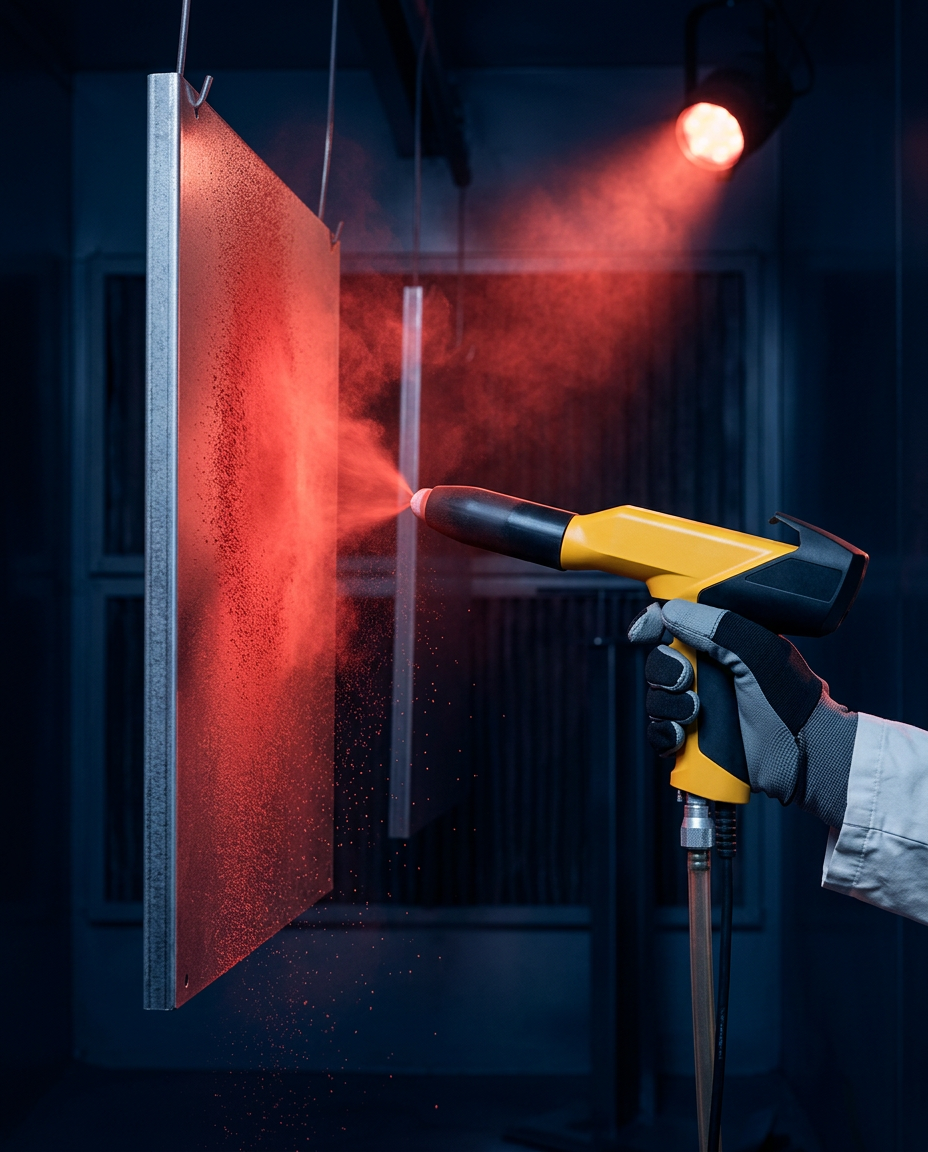
An unpainted metal surface is neither aesthetically satisfying nor protected against external factors such as corrosion and scratching. Electrostatic powder coating is a coating method that improves surfaces both mechanically and visually: a dry powder paint is electrostatically charged, applied to the surface, and then cured in an oven.
This process can be applied to both metal and non-metal surfaces. It is used across a wide range of products — from windows, doors, furniture and facade systems to industrial machine parts and automotive components. Surfaces such as MDF, glass and ceramics that can be suitably preheated can also be coated with powder.
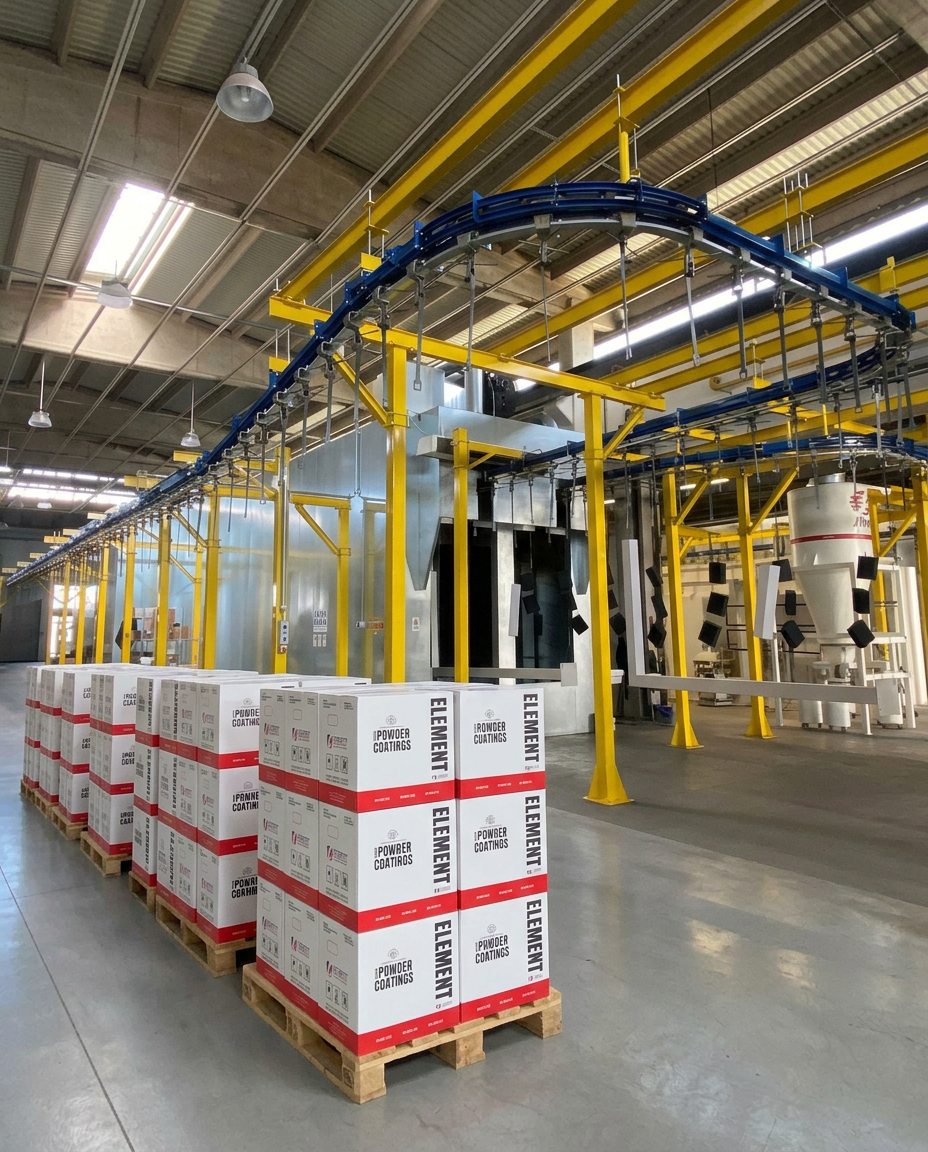
Application generally takes place automatically along a conveyor line: the part is first prepared, then coated with electrostatically charged powder, and finally heated in an oven to form a permanent film.
Why powder coating?
Solvent-free
No VOC (volatile organic compound) emissions — no solvent vapor forms during application or curing.
Protection and aesthetics combined
Protects against corrosion, impact and scratching while giving the surface color and appearance.
Durable surface
Forms a harder, more wear-resistant film layer compared to liquid paint.
Approximately 100% material efficiency
Powder that does not adhere to the surface during application is recovered in the booth and reused.
Superior results in a single coat
A single layer provides sufficient thickness and appearance in most applications, with no extra coat required.
High mechanical strength
Shows clear superiority over liquid paint systems in impact, flexibility and abrasion tests.
Easy and clean application
A clean, automation-friendly process with no risk of dripping, sagging or splashing.
Applicable to various surfaces
In addition to metal surfaces, it can also be used on preheatable MDF, glass and composite surfaces.
What is powder coating made of?
Powder coatings are dry mixtures obtained by homogeneously blending and melting four main components.
Binders (Resin + Hardener)
Forms the basic skeleton of the powder coating; determines the mechanical strength, chemical resistance and outdoor performance of the final film.
Additives
Improve performance properties such as flow control, degassing, UV resistance, corrosion resistance and electrostatic chargeability.
Pigments and Colorants
Provide color and opacity; selected to withstand curing temperatures in terms of thermal stability and light fastness.
Fillers
Natural minerals such as calcium carbonate — add bulk and optimize the pigment/binder/filler ratio to adjust packing density.
Resin types
The choice of resin in the binder system directly determines the coating's outdoor durability, chemical resistance and appearance. Element Boya offers the following main resin families in its portfolio.
Polyester
Superior outdoor durability — preferred for garden furniture, facade profiles and architectural applications.
Epoxy
High mechanical strength and corrosion resistance — common in industrial and automotive parts.
Polyurethane
Offers smooth and glossy surfaces — used in applications requiring a special appearance.
Epoxy-Polyester (Hybrid)
Combines the strengths of epoxy and polyester — a balanced solution with a wide range of uses.
Acrylic
High color and gloss retention — stands out in decorative and architectural applications.
How is powder coating made?
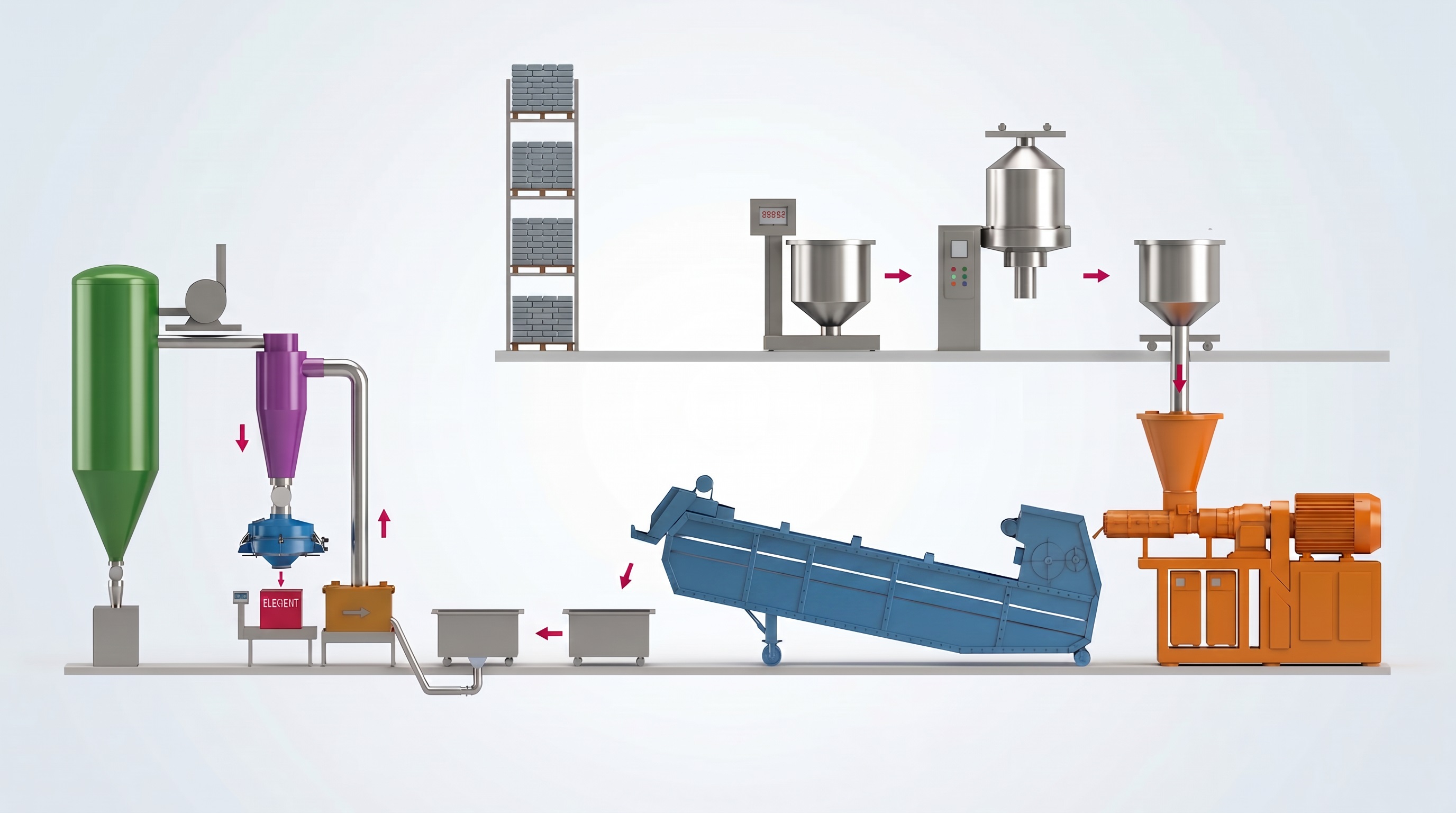
Every powder coating starts with a recipe specially designed according to the customer and intended use before production begins. The production process consists of eight main steps.
Formulation
The recipe is determined by R&D according to the requested color, gloss and performance.
Weighing
All raw materials in the recipe are weighed with precision scales according to the formula.
Mixing
The weighed raw materials are homogenized in horizontal-vertical mixers at a defined speed and duration.
Extrusion
The mixture is melted in an extruder with heat and shear force, turning it into a fully homogeneous mass.
Cooling
The hot mass coming out of the extruder is solidified on a cooling belt and broken into small chips.
Milling
The solidified mass is first ground into coarse particles, then milled into micron-sized powder.
Sieving
Unwanted coarse particles and fine dust are separated using sieves and suction systems.
Packaging
The finished product undergoes lot-based inspection and is packaged airtight.
28 Silos, Zero Error.
Element Boya produces with a fully automatic weighing system consisting of 28 silos of 2 tons each — a technology found in very few powder coating manufacturers worldwide. All raw materials in the recipe are weighed untouched, with digital precision and zero error.
Silos
Capacity / Silo
Error Margin
The application process
in three steps.
Surface Pretreatment
Dust, rust, oil and oxide layers on the surface are removed using chemical or mechanical methods. A conversion coating layer is formed on the surface to improve corrosion resistance and adhesion. The part is fully dried before application.
Electrostatic Application
The powder is electrostatically charged as it passes through the spray gun. The charged powder cloud, directed toward the grounded part, adheres uniformly to the surface through electrostatic attraction.
Curing (Baking)
The coated part is cured in an oven at 110–250°C. At this temperature, the powder first melts, then chemically cross-links and hardens, forming a permanent, durable film.
Deep dive into the science
How does powder coating actually stick?
Explore corona discharge, mirror charge and the Faraday cage effect with animations.
216 RAL shades and
special surface effects.
Powder coatings can be produced in virtually any color, surface texture and gloss level. The RAL Classic color system is used as the industry standard for color selection. In addition, special pigments can be used to achieve metallic, hammer-tone and salt and pepper finish effects; the surface can be finished as matte, satin, gloss or textured.
Explore the RAL Color Engine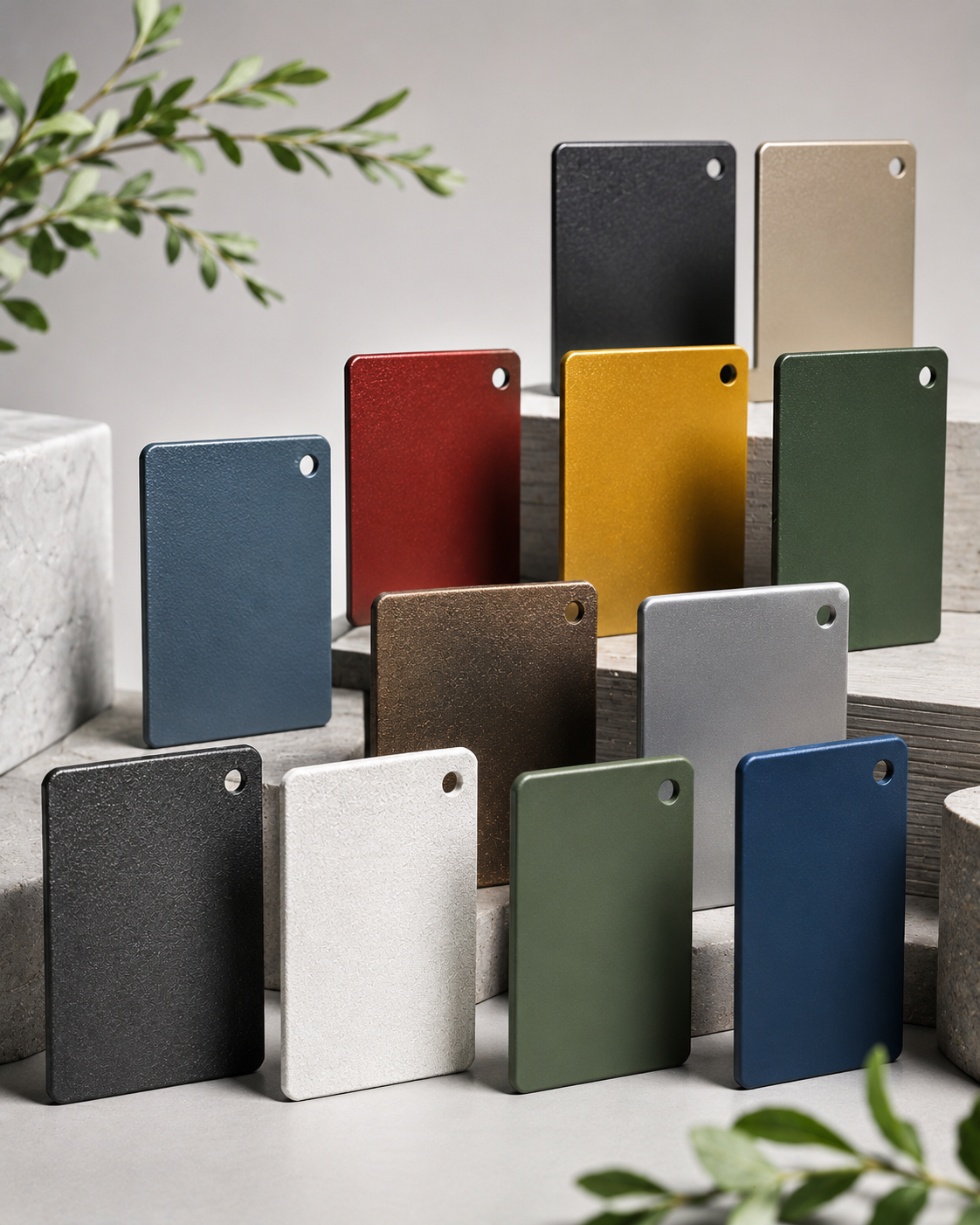
Differences between powder
coating and liquid paint.
| Criterion | Powder Coating | Liquid / Solvent-Based Paint |
|---|---|---|
| Solvent / VOC emissions | None — dry powder, solvent-free | Present — VOCs are released during application and drying |
| Material efficiency | Approximately 100% — excess powder is recovered | Low — losses from overspray and dripping |
| Film thickness / number of coats | Target thickness usually in a single coat | Often requires multiple coats |
| Curing method | Heat curing in an oven (110–250°C) | Drying at room temperature or low temperature |
| Mechanical strength | High resistance to impact and abrasion | Generally lower mechanical strength |
| Storage and transport | Not classified as flammable liquid, safer | Requires extra safety precautions due to solvent content |
Environmentally friendly
by nature.
Powder coatings contain no heavy metals, no solvents, and release no VOCs (volatile organic compounds) during application or curing. This makes powder coatings one of the lowest carbon-footprint coating methods available.
Unlike solvent-based liquid paints, powder coating is an inherently environmentally friendly technology that does not compromise on quality or performance. At Element Boya, we continuously improve energy efficiency and powder recovery rates in our production processes.

Which industries
use it?
Architecture & Construction
Facade profiles, window/door frames, railings and building components.
Transportation
Wheels, chassis parts and vehicle accessories.
Industrial Machinery
Machine bodies, electrical panels, agricultural equipment.
Furniture
Metal furniture, shelving systems and office equipment.
Job Shop Coating
Flexible, quick-turnaround production for a wide variety of parts.
Special Surfaces
Preheatable MDF, glass and composite materials.
Let's find the right
formula for your project together.
Let our R&D team help you evaluate the right resin system, color and surface effect for your needs.